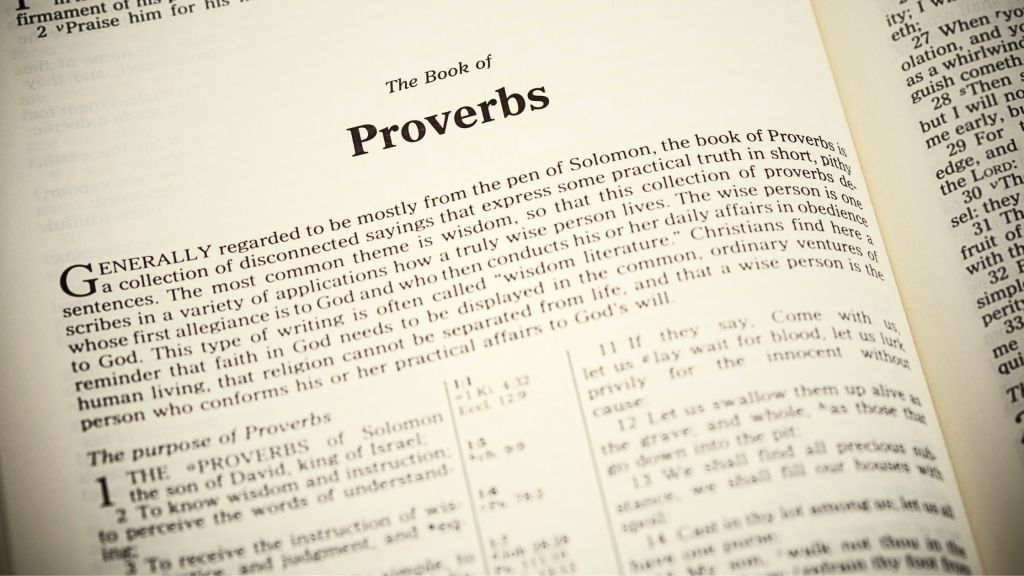
One spiritual discipline that I have is reading a proverb from the Bible every day. Essentially, what I do is turn to the Book of Proverbs, and based on the date, I read that Proverb. For example, today is October 20th, so I’ll read Proverbs 20.
The Book of Proverbs is believed to be written by King Solomon. It contains many tidbits of wisdom. A modern equivalent of this could be something like a “quote-a-day” calendar
In chapter 1, King Solomon share the purpose for writing the Book of Proverbs:
2 Their purpose is to teach people wisdom and discipline, to help them understand the insights of the wise.
3 Their purpose is to teach people to live disciplined and successful lives, to help them do what is right, just, and fair.
4 These proverbs will give insight to the simple, knowledge and discernment to the young.
5 Let the wise listen to these proverbs and become even wiser. Let those with understanding receive guidance
6 by exploring the meaning in these proverbs and parables, the words of the wise and their riddles.
7 Fear of the Lord is the foundation of true knowledge, but fools despise wisdom and discipline.
(Proverbs 1:2-7, New Living Translation).
Verse 7, “Fear of the Lord is the foundation of true knowledge…” could be considered the thesis of the Book of Proverbs.
One of my favorite verses in Proverbs is Proverbs 18:2. I think it is relevant to our current time. It reads, “Fools have no interest in understanding; they only want to air their own opinions.”
I think that this verse perfectly captures what we can witness on social media every day. When people argue online, regardless of topic, the focus does not appear to be on understanding, but solely on sharing opinions.
As Christians, we should not adopt the attitude of a foolish person. As I mentioned earlier, the Book of Proverbs emphasizes that the fear and honor of God is the foundation of knowledge, wisdom, and understanding. Therefore, we should embrace an attitude of understanding. A foolish person adopts an attitude of offense, whereas a wise person seeks understanding.
You might be wondering, “How can I cultivate an attitude of understanding?” One verse that comes to mind is James 1:19. It reads, “You must all be quick to listen, slow to speak, and slow to get angry” (NLT). When aiming for an attitude of understanding rather than offense, there are three things the Bible commands us to do:
- Be slow to speak.
- Be quick to listen.
- Be slow to anger.
- Be slow to speak. If you come across something on social media that makes you want to engage in a heated argument in the comments, take a moment to put down your phone, raise your hands, and step away from the keyboard. Instead, ask yourself why the post was offensive to you. While there might be a valid reason, you might also be missing something, leading us to the second point.
- Be quick to listen. Instead of immediately engaging in a public argument, reach out privately to the person involved. Send them a direct message and inquire about their intentions behind the post. What was their reason for sharing it? What kind of reaction were they expecting? They might provide clarity on something you overlooked. Matthew 18:15 advises us that if someone offends us, we should approach them privately and address the issue. If they listen and acknowledge their wrongdoing, we can mend the friendship. Consider how many friendships have been broken due to misunderstandings or social media arguments.
- Be slow to anger. The reality is that the person who posted something offensive or hurtful might have intended to offend, divide, or hurt others. Part of understanding is not stooping to their level and adopting an offensive attitude ourselves. Proverbs 19:11 explains that it is to our glory to overlook an offense. This doesn’t diminish the offensiveness or hurtfulness of their words. However, it shows that we are taking the high road and embodying the attitude of understanding conveyed in Proverbs.
While scrolling through social media, I encourage you to remember those three things when encountering posts.
And if I said something in this post that offended you, feel free to send me a message, and we can discuss it.
 Nick Chellsen
One thought on “THE ATTITUDE OF UNDERSTANDING”