Table of Contents
- Table of Contents
- Introduction
- Leading Yourself
- Leading Your Family
- Leading Your Community
- Leading Your Workplace
- Leading Your Church
- Conclusion
- Notes
Introduction
Hey, you. Yes, you! If you only get one thing out of this essay, I want it to be this— you are a leader!
Read that statement again and highlight it. You are a leader! Write it on a post-it note if you have to because I don’t want you to forget it.
Do you have reservations about being called a leader? I can understand if you do. You might think to yourself:
- I’m not the boss at work.
- I’m not the lead pastor at church.
- I’m not the most popular of my friends.
- I’m not the head of my household.
If you thought of any of those things, let me tell you something—leadership has nothing to do with what you’re not. Rather, leadership is all about your influence.
Leadership expert, John C. Maxwell defines leadership as “influence.”1 Meaning, if you have influence, you are a leader.
I think it’s safe for me to assume that you have influence. Think about the people around you: your family, friends, coworkers, or church members. That’s what I call your circle of influence. If anything, you at least have influence over yourself.
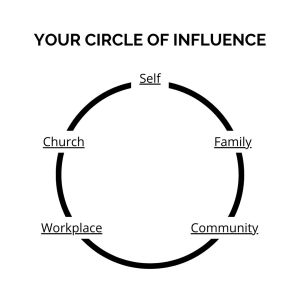
In this short essay, I will help you understand your circle of influence. I will show you from a Christian perspective that regardless of your power, position, or popularity, you are a leader.
Leading Yourself
Your circle of influence can be made up of anyone you have influence on. There are five categories that I have identified in a person’s circle of influence. Let’s take a closer look at each.
The first category in your circle of influence is yourself. Before you can lead anyone else, you must first be able to lead yourself. I think this is what Jesus meant when He said, “First take the plank out of your own eye, and then you will see clearly to remove the speck from your brother’s eye” (Matthew 7:5).
Four ways you can lead yourself:
- Physically
- Mentally
- Emotionally
- Spiritually
Anytime you exercise, you are leading yourself.
Anytime you learn a new skill, you are leading yourself.
Anytime you control your emotions, you are leading yourself.
Anytime you read your Bible, go to church, listen to worship music, or pray, you are leading yourself.
Think about it: What are some other ways you can lead yourself physically, mentally, emotionally, or spiritually?
Leading Your Family
The second category in your circle of influence is your family. Similar to how you cannot lead others until you can lead yourself, you also won’t be able to lead groups of people until you can lead your family. The apostle Paul wrote, “If anyone does not know how to manage his own family, how can he take care of God’s church?” (1 Timothy 3:5).
Your family can include:
- Spouse
- Kids
- Parents
- Siblings
- Grandparents
Anytime you support your spouse, you are leading your family.
Anytime you make a financial decision, you are leading your family.
Anytime you teach your kids, you are leading your family.
Anytime you help your parents or grandparents, you are leading your family.
Think about it: What are some other ways you can lead your family?
Leading Your Community
The third category in your circle of influence is your community. A community is defined by its leaders. Without good leadership in place, a community will not thrive on its own. Proverbs 11:14 reads, “For lack of guidance a nation falls, but victory is won through many advisers.”
Your community can include:
- Friends
- Neighbors
- Business owners
- Educators
- Emergency response providers
- Local officials
Anytime you help a friend through a hard situation, you are leading in your community.
Anytime you organize a neighborhood gathering, you are leading in your community.
Anytime you promote and support local businesses, you are leading in your community.
Anytime you partner with local agencies, you are leading in your community.
Think about it: What are some other ways you can lead in your community?
Leading Your Workplace
The fourth category in your circle of influence is your workplace. While your workplace might not be your favorite place to be. God cares about your work ethic. Because of this, your leadership in your workplace should reflect Him. The apostle Paul writes, “Whatever you do, work at it with all your heart, as working for the Lord, not for human masters” (Colossians 3:23).
Your workplace can include:
- Boss(es)
- Board members
- Consultants
- Coworkers
- Independent contractors
- Customers
Anytime you contribute to your organization’s success, you are leading in your workplace.
Anytime you voice concerns in a meeting, you are leading in your workplace.
Anytime, you help a coworker solve a problem, you are leading in your workplace.
Anytime you assist a customer with a purchase, you are leading in your workplace.
Think about it: What are some other ways you can lead in your workplace?
Leading Your Church
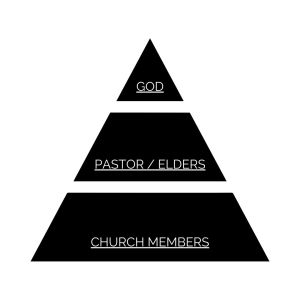
The fifth category in your circle of influence is your church. While church could be a subcategory of community, I think it is important to differentiate the two. The reason is that there are often formal leadership structures in churches (see image). These same leadership structures are not as common in informal communities like friend groups.
Your church can include:
- Pastor(s)
- Elders
- Volunteers
- Members
- Attendees
Just as a church is known by its people, it is also known by its practices. Acts 2:42 describes the practices of the early church. It reads, “They devoted themselves to the apostles’ teaching and to fellowship, to the breaking of bread and to prayer.”
In this passage, we see that Scripture, community, worship, service, and prayer were key components of the early church. Because of this, I would argue they should also be components of the modern church and practices of Christian leaders today.
Anytime you teach Scripture, you are leading in your church.
Anytime you get a visitor connected with your faith community, you are leading in your church.
Anytime you help someone participate in worship, you are leading in your church.
Anytime you volunteer to serve, you are leading in your church.
Anytime you pray with someone, you are leading in your church.
Think about it: What are some other ways you can lead in your church?
Conclusion
I want to leave you with one more thing—Influence, and therefore leadership, is reciprocal. Meaning, just as you have an opportunity to lead the people in your circle of influence, they also have an opportunity to lead you. That doesn’t make you any less of a leader. In fact, the best leaders are also the best followers. It’s the irony of leadership. Jesus Christ is the perfect example of this.
Scripture tells us Jesus was the perfect human (1 Peter 2:22). Because of this, we can conclude He was also the perfect leader. In His perfect leadership, He followed what God was calling Him to do.
(Christ), being in very nature God, did not consider equality with God something to be used to his own advantage; rather, he made himself nothing by taking the very nature of a servant, being made in human likeness. And being found in appearance as a man, he humbled himself by becoming obedient to death— even death on a cross! (Philippians 2:6-8)
To summarize, Christ did not use His leadership to gain power, position, or popularity. Instead, He used His leadership to help those in His circle of influence.
You are a leader!
As you’ve seen in the examples throughout this essay, being a leader means helping those in your circle of influence. Anytime you help someone else, you are a leader.
Notes
- John C. Maxwell, The 21 Irrefutable Laws of Leadership (Nashville: Thomas Nelson, 1998), 20.
 Nick Chellsen