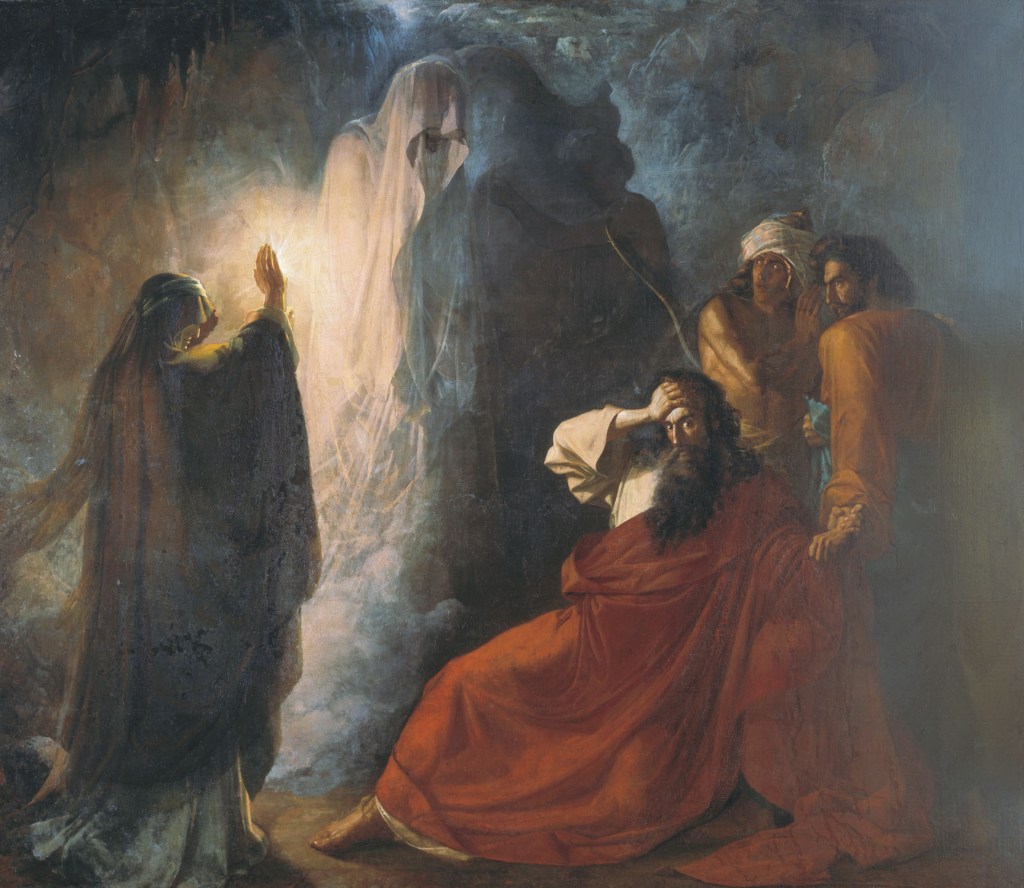
A Bible Story or a Ghost Story? (Or both?)
The Witch of Endor and the Ghost of Samuel
It sounds like the title of a low-budget Halloween movie. However, it’s actually an often-overlooked story in the Bible.
I think one of the reasons this story is often overlooked is because it raises theological questions about the supernatural. These are questions that Christians still wrestle with today. Questions like Are ghosts real? or What does the Bible say about ghosts?
The Setting: Saul’s Fear and God’s Silence
This story is found in 1 Samuel 28. At that particular moment, the prophet Samuel had just died, and the army of Israel was preparing to go to battle with the Philistine Army.
Verses 5-6 read, “When Saul saw the vast Philistine army, he became frantic with fear. He asked the Lord what he should do, but the Lord refused to answer him, either by dreams or by sacred lots or by the prophets” (NLT).
One of the ways God had previously spoken to Saul was through the prophet Samuel. However, Saul regularly disregarded Samuel and disobeyed God (1 Samuel 13:1-15, 1 Samuel 15). Because of this, Saul’s relationship with God had become estranged, and communication was cut off.
Saul Turns to Forbidden Guidance
Out of desperation, Saul decided to consult a medium, despite the practice being forbidden (Leviticus 19:31, 20:27). There was a witch in Endor who claimed she could communicate with the dead. So Saul disguised himself and went to see her at night.
He asked her to bring Samuel up. She reluctantly agreed. To the witch’s apparent horror and surprise, the ghost of Samuel appeared. Saul asked him what he should do.
The Ghost’s Message to Saul
The ghost of Samuel replied, “Why ask me, since the Lord has left you and has become your enemy? The Lord has done just as he said he would. He has torn the kingdom from you and given it to your rival, David. The Lord has done this to you today because you refused to carry out his fierce anger against the Amalekites. What’s more, the Lord will hand you and the army of Israel over to the Philistines tomorrow, and you and your sons will be here with me. The Lord will bring down the entire army of Israel in defeat.” (NLT, v. 15-19).
Two Major Interpretations of the Ghost Story
There are two different ways that this ghost story has been primarily interpreted:
- The ghost was truly Samuel.
- The ghost was pretending to be Samuel.
Interpretation 1: The ghost was truly Samuel
The first interpretation argues that the ghost was Samuel and that it was God (not the witch) who brought him up to rebuke Saul one last time. One of the reasons for this is that there is nothing in the text to suggest that it was anyone (or anything) other than Samuel. Essentially, it passed the “Duck Test.” It looked like Samuel, it acted like Samuel, and it talked like Samuel. Because of this, the original readers of this text would assume that it was, in fact, Samuel. Therefore, we can make the same assumption.
Additionally, the witch appeared to be horrified and even surprised when she saw Samuel (v. 12). Based on her reaction, some have suggested that this might have been the first time she had actually seen a ghost, and her previous conjurings were just simply tricks. This would reiterate that it was God and not her who brought Samuel up.
Finally, the prophecy that Samuel gave did come to pass. Saul and his sons died the next day, and the army of Israel was defeated by the Philistine army (1 Samuel 31).
Interpretation 2: The ghost was pretending to be Samuel
The second interpretation argues that the ghost was pretending to be Samuel. Essentially, is was an imitation or deceptive spirit. As I mentioned, God forbade witchcraft. Because of this, some argue that God wouldn’t involve a witch if He wanted to communicate with Saul, even if He was the one who actually brought Samuel up.
Additionally, God had already cut off communication with Saul because of his disobedience. Since there was no reconciliation or repentance on Saul’s part, it could be argued that there would also be no communication on God’s part.
Is This the Bible’s Only Ghost Story?
Scripture mentions spirits, visions, angels, and moments when people think they saw a ghost. However, the Witch of Endor and the Ghost of Samuel is the only full ghost story in the Bible, story where a deceased person appears and speaks.
This makes the story truly unique.
Seeing Past the Ghost: What This Story Is Really About
As I mentioned, this story raises theological questions about the supernatural. And both of these interpretations may raise even more questions for you. However, I don’t want us to miss the forest for the trees. Regardless of whether the ghost was Samuel or pretending to be Samuel, there is something bigger that can be seen.
This story shows just how far Saul’s disobedience took him away from God, so much so that Saul had made decisions that were antithetical to God and God’s word.
What This Story Teaches About Leadership
While this story raises a lot of theological questions, I think it also prompts some reflection questions for our lives and leadership. In my book, A Leader Worth Imitating, I explain that whatever we let influence us, is what we let lead us (Principle 5: Scripture). If we choose to be influenced by God’s word, we can trust Him to lead us. However, if we choose to be influenced by ways that go against God’s word, we are letting our sin influence us. The latter is is a path we do not want to follow.
Reflection Questions
- In your own leadership, is there any disobedience in your life that needs to be reconciled?
- When making leadership decisions, do you we seek out means or messages that are contrary to God and His word?
- When it feels like God is silent, what voices do you tend to turn to?
Originally posted on October 21, 2023. Last updated on October 31, 2025.
Subscribe
Subscribe to have posts like this emailed to you.
 Nick Chellsen
.jpg)