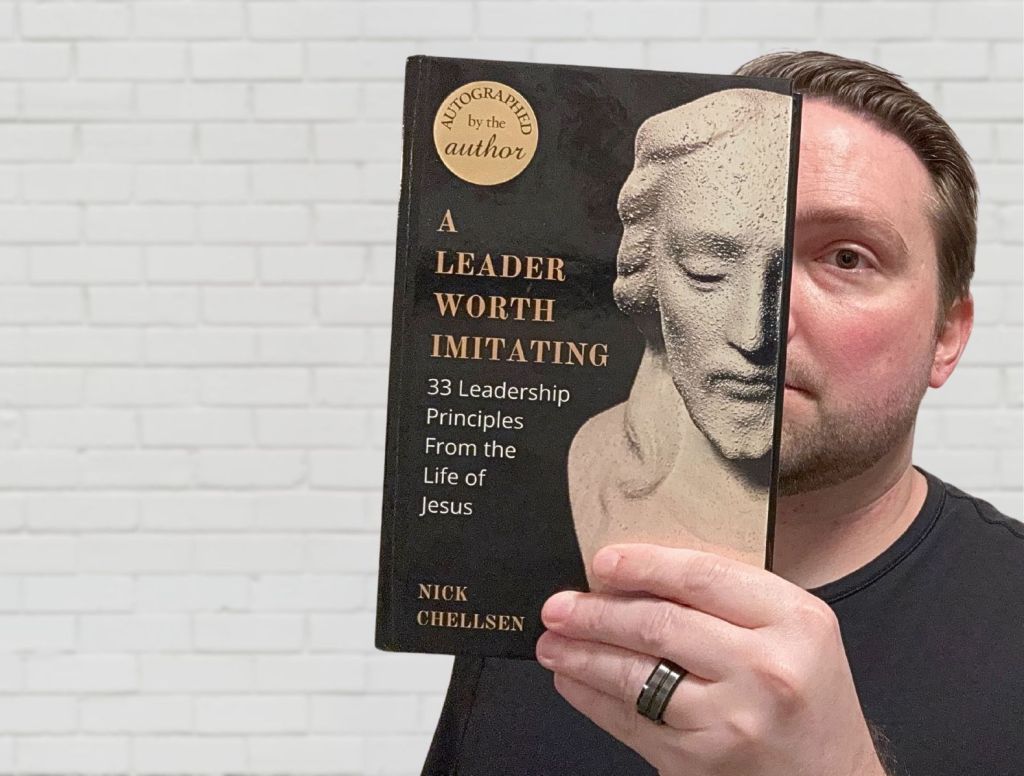
It’s been just over a year since I released my book, A Leader Worth Imitating: 33 Leadership Principles From the Life of Jesus.
If you haven’t read it yet, or if you are wanting a refresher, I’m going to summarize it in this post.
The Bible tells us that Jesus was perfect. 1 Peter 2:22 reads, “He committed no sin, and no deceit was found in his mouth” (NIV). Because Jesus was perfect, we can conclude that His leadership was also perfect. So by looking at the 33 years of His life, we can see what it truly means to be a leader.
…and that’s what this book is all about: How Jesus led, and how we can lead just like him.
This book is broken up into 33 chapters. Each chapter is 3-4 pages and covers 1 leadership principle. I discuss each principle by looking at an example from Jesus’ life in the Bible. In addition to this, I share how that principle played a role in his leadership as well as how it can help you be a better leader. I also end each chapter with 3 application questions to help the reader apply the principle to their life and leadership.
You can read this book in a couple of ways. You can read in the order it is written. Even if some principles don’t pertain to your leadership, you will see how all 33 work together. Since there are 33, you could treat this book like a daily devotional and read one a day. Alternatively, you could also read this book out of order. By browsing the table of contents, you can select which principles are currently the most relevant to you and your leadership.
While there are 33 leadership principles in this book, there are 5 specific principles that I want to cover in this post. You could think of these as “pillar principles.” While I don’t refer to them that way in the book, they are principles that I reference throughout it.
Principle 1: Purpose
The first principle I discuss in the book is purpose. A leader’s purpose is the reason he leads. He might call it his goal, cause, or mission. Also, a leader might say it’s what gets her up in the morning. It’s the reason behind everything she does.
In this book, I argue that the purpose of Jesus’ leadership was to reconcile humanity’s relationship with God. We see this in the covenants of the Old Testament as well as the new covenant Jesus started with his death and resurrection.
Throughout the book, I explain how the leadership decisions Jesus made were rooted in His purpose to reconcile humanity’s relationship with God.
Principle 7: Team
Another principle I discuss is team. While many may idealize the idea of DIY leadership or idolize lone ranger leaders, this isn’t an accurate view of leadership. You might do a lot of things well. However, you can’t do everything. You need help.
When we look at the leadership of Jesus, we see He had a team. His team comprised twelve men: Simon Peter, Simon the Zealot, James (son of Alphaeus), James (son of Zebedee), John, Andrew, Philip, Bartholomew, Matthew, Thomas, Judas Thaddaeus, and Judas Iscariot (Mark 3:16-19).
The funny thing is, if there was one leader who didn’t need a team, it was Jesus. He was the Perfect Leader. He could have done everything if He wanted to. However, despite His perfection, He showed us the value of having a team.
Principle 8: Inspire
Another principle I discuss is inspiration. There are two reasons someone might follow a leader: obligation or inspiration. Obligation is when you have to follow a leader. Inspiration is when you want to follow a leader. When we look at the leadership of Jesus, we can see that He inspired His team. An example of this is when He called His disciples in Luke 5:1-11.
If you’re familiar with this story, you’ll remember that this is when they caught so many fish that the nets almost broke and the boat almost sank. Peter is inspired by this miraculous sign and Jesus told the men that if they follow him, he will make them fishers of men. The story ends with them abandoning their nets and following Jesus.
Principle 11: Expectations
Another principle I discuss is expectations. Setting expectations is about helping your team know what they need to do.
When we look at the leadership of Jesus, we see His disciples knew what was expected of them. An example of this is when Jesus instructs His disciples to take up their crosses Luke 9:23 reads, “Whoever wants to be my disciple must deny themselves and take up their cross daily and follow me” (NIV).
There are two ways to think about the cross in this passage: physical and spiritual. A physical cross is the death of our bodies. A spiritual cross is the death of our will. In addition to this, you can only take up a physical cross once. However, you need to take up your spiritual cross every day.
Being a Christian isn’t easy. It requires us to die daily to our will. As a Christian leader, the work you and your team do may not be easy. However, it is your responsibility to not only set expectations but to model them.
Principle 30: Sacrifice
Another important principle I discuss is sacrifice. It can be easy to focus on what your purpose gives you. However, there will come a point when you have to give your purpose something. To fulfill your purpose as a leader, you will have to make sacrifices.
When we look at the leadership of Jesus, we see He made sacrifices to fulfill His purpose. There is no better example of this than His crucifixion.
When Jesus uttered His famous last words: “It is finished” (John 19:30, NIV), He was not referring to His life being finished. Rather, He was referring to His purpose being finished.
Through Jesus’ crucifixion, we see He sacrificed His life to reconcile humanity’s relationship with God.
As Christian leaders, we will also have to make sacrifices to fulfill our purpose. While we might not sacrifice our lives, we can live sacrificially for those we lead. By doing so, we practically imitate both the purpose and sacrifice of Jesus.
Other Principles
While those are the five pillar principles of A Leader Worth Imitating, I also share 28 other principles. I discuss the importance of:
- Being present with those you lead (Principle 2)
- Allowing your team to make mistakes (Principle 13)
- Being creative and innovative (15 & 16)
- Having empathy (Principle 26)
- Leaving a legacy (Principle 33)
…just to name a few more.
As you learn how to imitate The Perfect Leader, you will find yourself becoming a better leader for yourself, your family, community, workplace, and church.
…that’s the book!
If you liked the summary and the ideas I discussed about in this post, I would encourage you to check it out. And If you’ve already read the book, I’d appreciate it if you sent this to someone who you think would enjoy it or find it meaningful.
Purchase a copy at your favorite retailer, or get a free excerpt from my Leadership Toolbox.
Watch the accompanying video on YouTube: https://youtu.be/-doVaB_aQj8
 Nick Chellsen
One thought on “A Leader Worth Imitating | Summarized by the Author (Nick Chellsen)”