Holy Week Reading Plan: Matthew 21:1-17
“Jesus flipped tables!”
You’ve probably heard Christians use this as justification when they act out in anger.
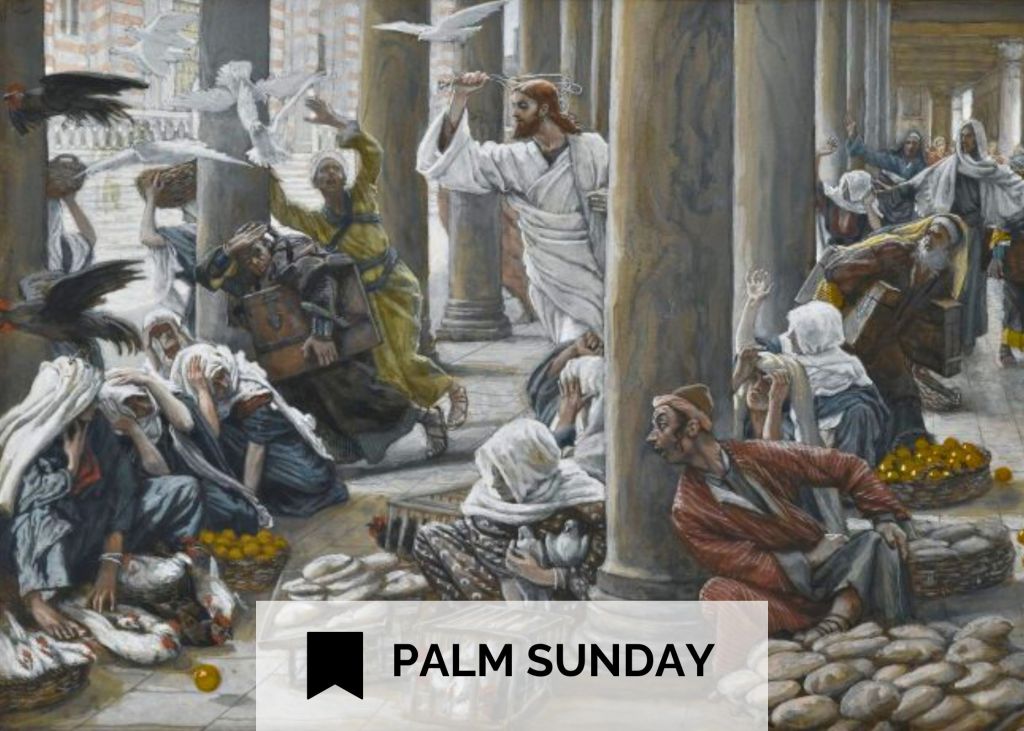
All four gospels document the story of Jesus flipping tables and cleansing the temple (Matthew 21:12-17; Mark 11:15-19; Luke 19:45-48; John 2:13-16).
It’s important to note that Jesus flipping tables was likely not a one-time thing. Many scholars argue that the account in John’s gospel was at a different time than the accounts in the Synoptic Gospels (Matthew; Mark; Luke). The reasoning for this is that John documents this happening at the beginning of Jesus’ ministry while Matthew, Mark, and Luke document it happening at the end of His ministry.
My wife has taken this argument one step further and concluded that these were the only times documented. John’s gospel documents three Passover events during Jesus’ ministry (John 2:13, 6:4, 11:55), so it’s within the realm of possibility that Jesus flipped tables and cleansed the table at least one other time.
While we can conclude that flipping tables was a part of Jesus’ earthly ministry, it’s important to know why He did it as well as what He did immediately after.
In this story, Jesus saw people buying and selling animals for sacrifice. He flipped over the tables and kicked out the merchants (Matthew 21:12-13; Mark 11:15-16; Luke 19:45; John 2:14-15).
In my book, A Leader Worth Imitating, I explain that Leviticus details several reasons for needing a sacrifice. Usually, these sacrifices required lambs. In Matthew’s account of this story, he specified Jesus flipped tables that were selling doves (v. 12). This is an important detail. According to Jewish law, if someone could not afford a lamb to sacrifice, doves were an acceptable substitute (Leviticus 12:8). Because of this, the merchants were likely taking advantage of the poor.
In Matthew 21:13, Jesus said, “My Temple will be called a house of prayer,’ but you have turned it into a den of thieves!” (New International Version). Essentially, they were stealing from the vulnerable.
While Jesus’ anger led Him to flip tables and kick people out, He didn’t stop there. Matthew’s account of this story reads, “The blind and the lame came to him at the temple, and he healed them” (v. 14, NIV). Luke’s account adds, “Every day he was teaching at the temple” (v. 47. NIV). By doing this, Jesus restored the temple to a house of prayer, a place to connect with God, as it was meant to be.
The story of Jesus flipping tables and cleansing the temple shows us that He sometimes flipped the tables of thieves. However, other stories in the Bible show us that He also sometimes sat at the tables of thieves. An example of this is the story of Zacchaeus the tax collector.
This story is documented in Luke 19:1-10. As the chief tax collector, Zacchaeus would have made his wealth from stealing from others. We would have been a perfect candidate for having his table flipped by Jesus. However, that’s not what Jesus did.
When Jesus was passing through Jericho, Zacchaeus went to see Him. However, Zacchaeus was a small man, so he had to climb a tree to see Him (v. 3). Upon seeing Zacchaeus, Jesus called out to him, “Zacchaeus, come down immediately. I must stay at your house today.” (v. 5, NIV).
Zacchaeus’ encounter with Jesus led him to give half of his possessions to the poor and return four times the amount to those he had stolen from.
Yes, Jesus flipped the tables of thieves. But He also sat at the tables of thieves. He removed thieves and reproved thieves. It takes god-tier discernment to know which one to know which one to do.
So when you get angry at the injustice you see, before acting out in anger, ask yourself this: Is this someone who needs to be removed or someone who needs to be reproved? And if you do decide to remove someone, how can help restore that space?
Subscribe
Subscribe to have posts like this emailed to you.
 Nick Chellsen
_-_James_Tissot.jpg)
One thought on “Palm Sunday: Let’s Talk About Flipping Tables”